
'Nobody Sees Me' Means Two Different Things
"I just feel like nobody really sees me" comes out of two completely different inner states. The manager response that helps one of them quietly wounds the other.

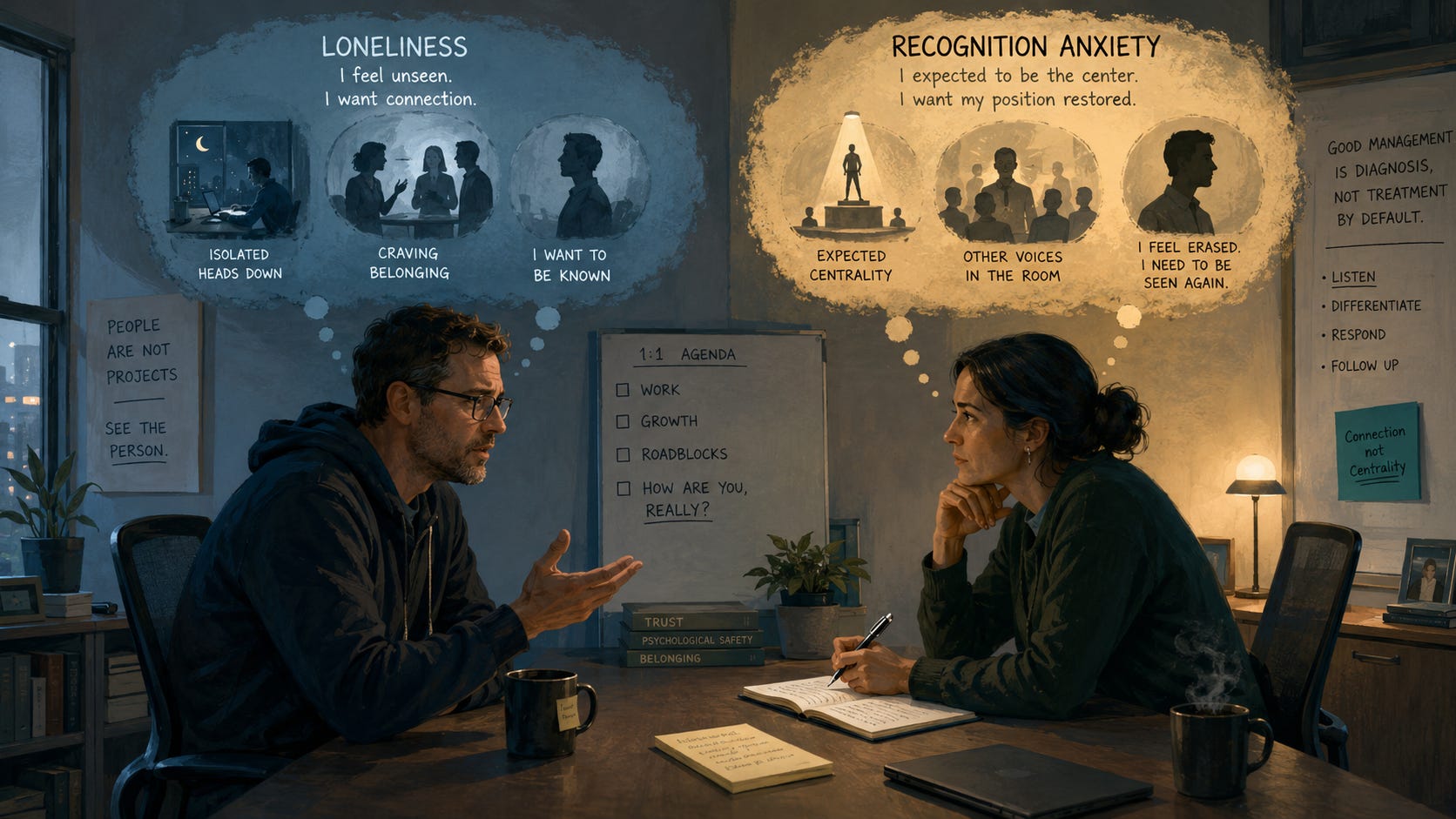
A Thursday afternoon 1:1
It’s a Thursday afternoon, Marcus is in your 1:1 slot, and three minutes in he says the thing you’ve heard a dozen times: “I just feel like nobody really sees what I’m doing here.”
You nod. You’ve heard this from Priya last month, and from Ben before that, and from yourself, honestly, about your own boss. It’s the most familiar sentence in engineering management. You have your usual moves ready. Ask about specific projects. Talk about visibility. Surface his work in the next staff review. Mention him in skip-level. The script almost runs itself.
What’s underneath the sentence
That same sentence comes out of two completely different inner states, and most of us, myself included, are not catching the difference until much later, when the response we offered didn’t land.
One version of the sentence is loneliness. The person across from you is isolated. They don’t have peers they trust. They don’t have a manager relationship that feels like being known. They’ve been heads-down on infrastructure for six months and they’re starting to feel like a function rather than a human. Their nervous system is asking for contact. When they say “nobody sees me,” they mean it the way someone in a new city means it. They want to be known.
The other version is something else, and it took me a long time to be able to name it. The person’s nervous system isn’t asking for contact. It’s asking for the restoration of a position they expected to hold and don’t. They walked into this team, or this company, or this seniority level, with an expectation that a certain kind of deference and centrality would come with the territory. It hasn’t. Or it has, partially, but the room now has other voices in it, and the math has shifted. When they say “nobody sees me,” what they mean, underneath, is something closer to: I expected to be the reference point in this room, and I’m not, and that feels like erasure.
The sentences are identical. The inner states are not. And here’s why this matters: the manager move that helps one of them quietly wounds the other. Promotion-as-recognition, more visibility, more credit in the next staff meeting, these feed the second pattern. They train the person, and the org around them, that the way to handle the feeling of not being centered is to be centered harder. You’re not solving the underlying experience. You’re confirming that the underlying experience is the right one to have.
I’ve been circling this kind of misread for a while in different contexts. A few weeks ago I wrote about engineering organizations reading women’s higher risk perception of AI as a deficit of enthusiasm, when the more honest read was that it was a surplus of accuracy. The shape of the mistake is the same: a signal from the people closest to the situation gets coded as a defect in the people sending it.
The frame I’ve been borrowing from Chemaly
An essay Soraya Chemaly published in May speaks to me on this, partly because while most of what she’s writing about isn’t about workplaces at all, but instead because it maps onto engineering organizations with a precision I find uncomfortable. Her central move is to separate loneliness from what she calls recognition anxiety. Loneliness is a deficit of intimacy. Recognition anxiety is a defensive response to losing default centrality. They share symptoms, withdrawal, irritability, a sense of injury, but they are not the same internal experience, and they don’t respond to the same interventions.
You’ve felt this from the other side, I’d bet. You’ve had a peer or a senior leader whose distress about “not being heard in the room” turned out, when you looked closely, to be distress about other people being heard as well. The two are easy to confuse from inside the feeling. The person experiencing it often can’t tell the difference themselves, because what the nervous system is registering is loss, and the loss feels like the same kind of loss whether what was lost was connection or centrality.
This is going to matter more, not less, in the teams you’re managing over the next five years. Some of the numbers in Chemaly’s piece I had to read twice. Fifty-seven percent of Gen Z men say society has gone too far on women’s equality. About a third, in an international survey, say a wife should obey her husband. These are the people in your junior pipeline right now, not the people you’ll hire in 2032. They are arriving more gender-conservative than the senior cohort hiring them, which inverts the assumption baked into most diversity work, which was that the kids would be more progressive and you just had to wait out the old guard.
I don’t surface that to be alarmist. I surface it because if you’re trying to read your team’s internal weather, the texture of recognition anxiety in your junior engineers is going to be louder and more confidently expressed than it was five years ago. The “I’m not being seen” sentence is going to come from people who have, by most external measures, been seen quite a lot. And the script that mostly worked for the previous generation, more visibility and more affirmation, will increasingly produce someone who feels more aggrieved, not less.
Inside the design review
The thing that helped me actually understand this is a concept sociologists have been working with for a long time, which is that masculinity in our culture is structured as a precarious state. Femininity is treated as something you simply are. Masculinity is treated as something you have to keep proving. There’s no stable resting state. A single perceived failure, like a junior pointing out a flaw in your design doc, registers in the nervous system not as a normal professional event but as a status threat that has to be repaired, usually visibly, in front of the same audience that witnessed the original event.
This is why disagreements in engineering escalate the way they do. The surface is technical. The transaction underneath is about who gets to be the reference point in the room. This is a thread I picked up from a different angle in The Diminisher in the Room: the senior engineer whose feedback always carries a quiet knife isn’t being difficult so much as regulating a status threat the design review surfaced. Same mechanism, different layer.
You’ve probably watched a code review thread balloon to forty replies over something that could have been a one-line comment. You’ve watched a senior engineer dig in on an architectural position past the point of usefulness, past the point even of his own apparent belief in it. The technical merits of that disagreement are not what’s being negotiated, which is one reason these threads don’t resolve when you try to mediate them on the merits. You’re addressing the wrong layer.
What I keep coming back to
Which leaves you, the person reading this, in an awkward position. Because the move that would actually help is one most engineering organizations aren’t set up to make, which is to stop treating recognition-anxiety distress and loneliness distress as the same problem. The first one needs you, gently, to not feed it. The second one needs you, very much, to lean in. Telling them apart is the whole game, and there’s no checklist for it. The signal I’ve come to trust, imperfectly, is what happens when other people in the room also get acknowledged. If your engineer’s distress eases when their peer gets visible credit, it was probably loneliness. If it intensifies, you’re looking at the other thing.
I don’t have a clean ending for this. I’ve been sitting with Chemaly’s piece for while and what I keep arriving at is that the toolkit most of us were trained on was built for a version of this problem that’s only a piece of what’s actually walking into our teams now. The work, I think, is going to be in learning to hold steady when the script tells you to fix something and the fix would make things worse. I don’t know what to call that skill yet. I know I don’t have it reliably, and I know the managers I’ve watched do it well are doing something quieter than what the standard playbook recommends.